
Banana leaf for food service in Singapore & Malaysia — what to spec before you buy
By the TapakNusa export desk · updated 2026-09-12. For nasi lemak stalls scaling up, otak-otak grills, kuih makers, hotel banquets and central kitchens: the leaf specs that actually matter, and how to trial them without risk.
The direct answer
Spec three physical things — length ≥100 cm, no visible tears, washed — and buy fresh vacuum-packed for Singapore and West Malaysia lanes of 3-7 days. Trial without risk: a courier sample under 30 kg ships door-to-door in 3-7 days, the product is free (courier at cost, credited to your first PO), and only after your kitchen passes it do you take a ~100 kg LCL trial lot.
1. Four use cases, four different leaves
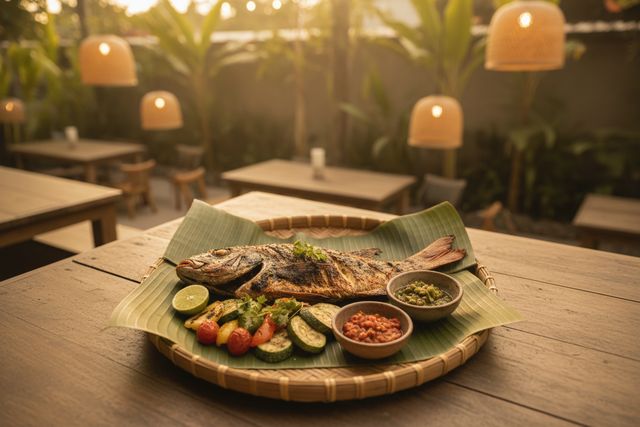
"Banana leaf" is not one product. A nasi lemak wrap needs a wide, clean surface with no tears — the leaf is the plate and the customer sees it. Otak-otak and grilled applications need leaves that fold over heat without cracking along the spine. Kuih and steamed cakes are cut to liner size, so shorter leaves are fine but the surface must be clean. Banquet plating wants the longest, most uniform leaf you can get. Tell your supplier the dish, not just the quantity — if they cannot map your dish to a spec, they are reselling, not sorting.
2. The three specs that actually matter
Length. Export grade: 100 cm and a wrap becomes two pieces. We treat ≥100 cm as our export floor, with longer lengths by lot availability. Tears and holes. One small edge tear is workable for liners, not for a visible wrap — our export standard means none visible. Cleanliness. Leaves should be washed and free of spots and dust; a wiped-but-never-washed leaf shows up the moment food sits on it. Everything else — "premium", "AAA", variety names — is marketing until those three are written down and sorted to.
3. Fresh vacuum-packed vs frozen
For Singapore and West Malaysia, fresh vacuum-packed leaves are the practical default: sea or road lanes of 3-7 days from Java are well inside fresh handling, packing density is far better (folded, vacuum-sealed 1-2 kg packs in ventilated cartons), and kitchens get a leaf that behaves like a fresh leaf — pliable at room temperature, no thaw drip. Frozen leaf earns its keep on long lanes and for bulk grilling programs; if your supplier pushes frozen for a Singapore weekly order, ask why. Shelf life under chilled handling is a function of pack date and temperature — we state it per lot instead of promising a magic number.
4. How a trial actually works
The honest path is small and fast. Step one: send your dish, pack preference and weekly volume band — a human replies within one working day with the spec sheet and a sample quote against it. Step two: a courier sample under 30 kg ships door-to-door (3-7 days to Singapore and most of Malaysia), packed exactly like export orders; the product is free, courier runs at cost, and the cost is credited against your first PO. Step three: your kitchen tests it on the real dish. Only then do we quote a standing trial lot of roughly 100 kg by LCL — and volume beyond that is quoted once capacity is verified in writing. No supplier should ask you to skip step three; we certainly don't.
5. The paperwork, both sides of the causeway
Every shipment leaves Indonesia with a Certificate of Origin, invoice and packing list whose lot codes and weights match the cartons; a phytosanitary certificate is issued on request. On your side, the fresh-produce import licence belongs to the importer — in Singapore that is SFA registration/licence for consumption produce (cartons carry producer, product and pack-date per SFA labelling). We prepare export documents to match whatever your authority requires; your forwarder or ours can handle the arrival side.
What we can honestly promise today
We are a young exporter and we sort our own leaves — grading by physical spec (length, tears, cleanliness), with variety and farm origin stated per lot. Availability is confirmed case by case while our supplier verification round runs; that is why the trial path above exists. No fake grades, no stock photos, no certificates we don't hold.
Questions from kitchens
Which banana leaf variety do we get?
We grade by physical specification, not by variety name. Varieties (Batu/Klutuk, Tanduk, Kepok) follow the season and are stated per lot; tell us your use case and we match the leaf to it. What stays constant is the spec: the export grade means no visible tears, ≥100 cm, washed, mature green leaf.
Can we try before committing to a pallet?
Yes — that is the intended path. A courier sample under 30 kg ships door-to-door in 3-7 days to Singapore and most of Malaysia, packed the same way as export orders. Trial lots of roughly 100 kg by LCL follow once the sample passes your kitchen test.
What documents come with a shipment?
Every shipment carries a Certificate of Origin, invoice and packing list whose lot codes match the cartons; a phytosanitary certificate is available on request (Singapore treats fresh leaves for consumption as produce under SFA rules, so phyto is not required there — we issue it for destinations that ask). On the Singapore side, SFA registration/licence of the importer of record is what applies — that stays with the importer.
Continue: full spec sheet · importer FAQ guide · request a sample quote. More notes: notes from the export desk.